The Honest Guide to Building a Faceless YouTube Channel with AI
Faceless YouTube channels are growing fast, and AI makes them more achievable than ever. Here's what actually works, and what most tutorials won't tell you.
Let’s skip the part where we tell you that faceless YouTube channels are "a massive opportunity", and you should "start today." You already know this. You've seen the finance channels, the history narrations, the AI tool reviews, no face, no personality, just well-made content pulling hundreds of thousands of views. You're here because you want to actually do it, not because you needed convincing.
So here's what I'll do instead: tell you what the process actually looks like, where people get it wrong, and how to use AI, specifically Videfy, to make the whole thing faster without making it worse.
The thing most people get backwards
A lot of new faceless creators think the hard part is production, when it’s really more than that. The AI handles production now. The hard part is picking something worth saying and saying it in a way that doesn't sound like every other video on the topic.
Think about the personal finance niche on YouTube. Thousands of channels. Most of them cover the same six topics with the same structure. The ones that break through aren't the ones with better cameras or slicker animations; they're the ones that take a position, give you a specific detail you didn't already know, or frame a familiar idea in a way that actually sticks.
Picking the right topic
The faceless format lives and dies on searchability. Without a personality to draw subscribers back, you're competing on discovery, which means you need people to be actively looking for what you're making.
YouTube's autocomplete is genuinely underrated for this. Start typing your topic and watch what it fills in. Those suggestions are real searches that real people ran today. If you type "how to stop living paycheck to" and YouTube finishes it, that's a signal. That's demand.
The sweet spot is a topic specific enough that someone watching it feels like it was made for them, but broad enough that "someone" is thousands of people per month. "5 money habits that keep people broke" works because the viewer self-selects. They click it because they recognize themselves in it. That recognition creates watch time.
Niches that tend to work well for faceless content: personal finance, history, geopolitics, technology, psychology, and business. What they have in common is that the information carries the video; you're not trying to entertain through charisma.
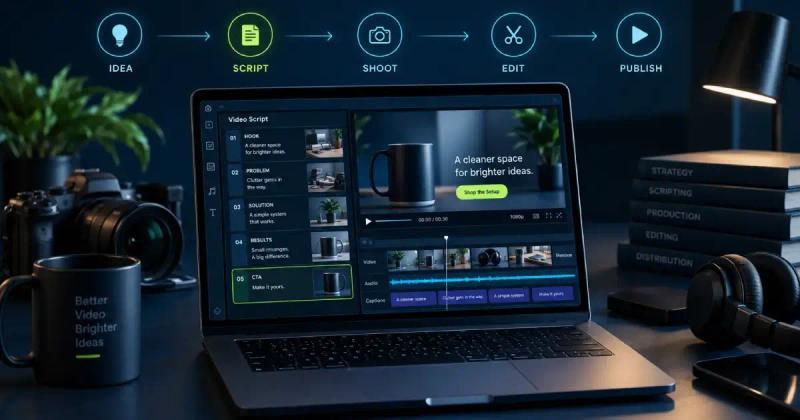
Writing the script (and why AI drafts aren't enough)
Videfy will generate you a script. It'll be decent: correct structure, reasonable length, logical flow. And if you publish it without touching it, your video will sound exactly like that: decent. Algorithmically fine. Forgettable.
The edit pass is when your channel is actually made. It takes maybe 20 minutes, and it's the difference between a video people finish and one they abandon at the 90-second mark.
What to look for:
The opening needs to earn the next 60 seconds, not summarize the whole video. "In this video I'll tell you five money habits that keep people broke" is not a hook. "If your income has gone up in the last three years but you feel exactly as financially stuck as you did before, this might explain why", that's a hook. It creates a specific tension.
Every claim should have a specific detail attached. Not "many people struggle with saving" but "the average American saves less than 4% of their income, and that number has barely moved in 20 years despite wages rising." Specificity is what makes a video feel researched rather than generated.
Cut the transitions that don't add anything. "Now that we've covered X, let's move on to Y" is filler. Just move on to Y.
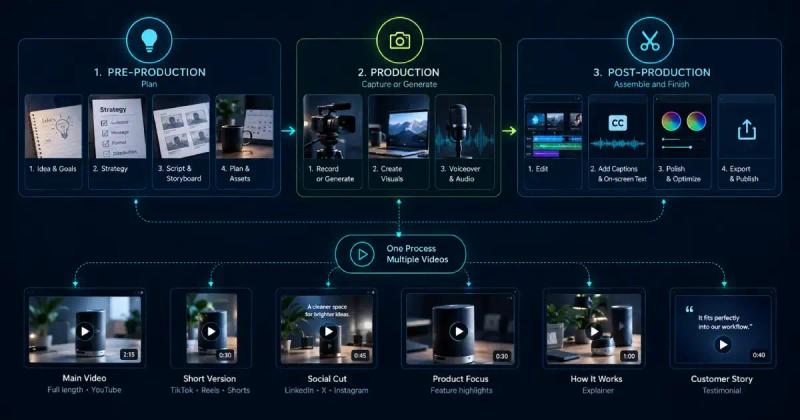
The production side (where Videfy does the heavy lifting)
Once the script is solid, the rest moves quickly.
Voice: Videfy's AI voiceover library is wide enough that you can find something that fits your content's tone. For most educational content, you want something that sounds like a confident person explaining something they know well, not a radio announcer, not a robot. Preview a few options with an actual chunk of your script, not just a stock sample sentence. Pick one voice and use it consistently. It becomes your channel's sound.
Visuals: Videfy auto-matches B-roll footage to each scene. It gets it right often enough that a quick pass, swapping out two or three clips that feel too generic, is all you need. The one thing worth adding manually: on-screen text for key stats or numbered points. Not because it looks fancy, but because viewers watching without sound (which is a lot of them) follow the video entirely through text overlays and captions. Treat them as a parallel version of your narration.
Music: The only rule is that it shouldn't be noticeable. Background music that distracts from the voice is worse than no music. Find something that matches the tone, set it to about 15% volume, and forget about it.
Captions: Generate them, scan for errors on any proper nouns or technical terms, then export as a separate SRT file to upload on YouTube rather than burning them in. YouTube indexes the text, which helps with search. Small thing, worth doing.
What the first few months actually look like
Your first video won't go anywhere. Probably your first five won't either. This isn't pessimism, it's just how YouTube works. The algorithm needs data about your channel before it'll recommend you to anyone, and that data takes time to accumulate.
What you're doing in those early months is learning. Watch your audience retention graphs obsessively. Not to feel bad about the drop-offs, but to understand exactly where and why people leave. A cliff at 45 seconds means your hook isn't holding. A gradual decline starting at minute 4 means you're running out of substance. Each video is data about what to fix in the next one.
The channels that grow are almost never the ones that started with the best videos. They're the ones that kept making them and got better faster than everyone else.
With Videfy cutting your production time down to under an hour per video, you can publish every week without burning out. That pace, sustained over 6 months, is where faceless channels start to compound.
One last thing
The AI doesn't make this easier by making it mindless. It makes it easier by removing the parts that were never the point, the camera setup, the editing software, the hours of rendering. What's left is the part that actually matters: figuring out what to say, and saying it well.
That part is still on you, and the good news is it's also the part that can't be automated away.
Learn with Videfy
Discover tutorials, AI best practices, feature updates, and creative inspiration to level up your video production.