Why Vertical Video Production Shouldn't Be a Hack
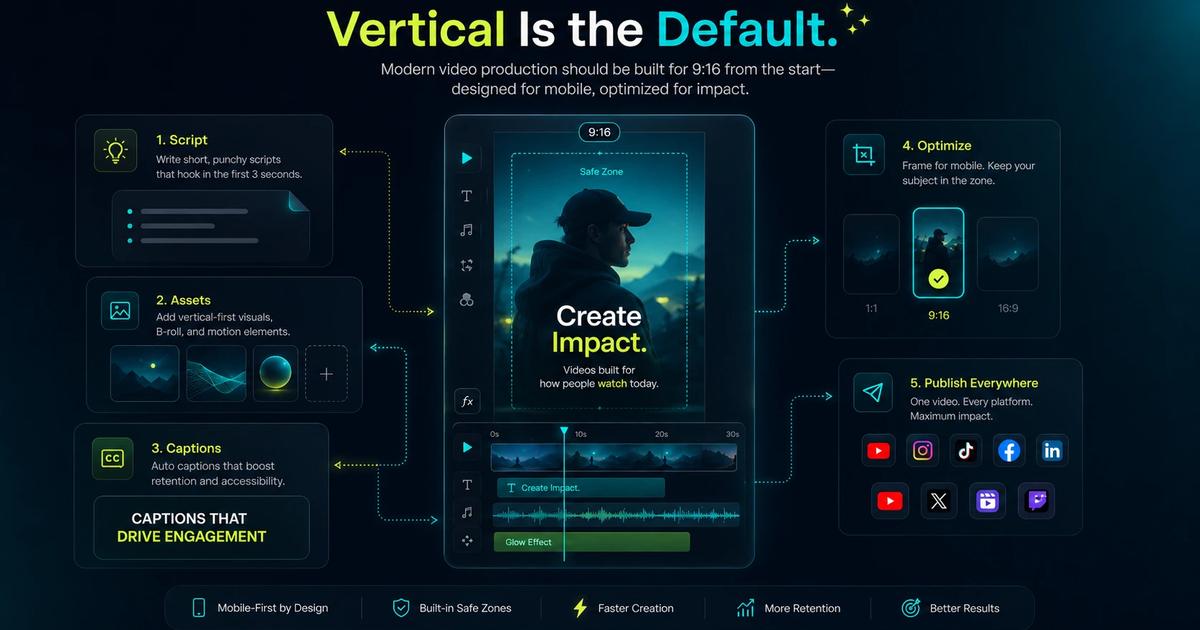
Learn how a smarter vertical video production workflow helps creators reframe, edit, adapt, and export 9:16 content without rebuilding every project.
Vertical video production is no longer a side workflow for social media. It has become one of the primary ways people watch, discover, and share video on mobile devices, yet the production process often still feels like an afterthought.
A creator starts with a landscape project, duplicates the timeline, changes the aspect ratio, moves the subject back into frame, adjusts the captions, resizes the graphics, checks whether anything important is sitting beneath platform controls, and then exports another version. If the same video needs to go to several platforms, that process repeats.
Technically, it works. But it is hard to call it an efficient workflow.
The real problem is not vertical video itself. The problem is that many production systems still treat 9:16 as something that happens after the creative work is finished. That assumption made sense when widescreen displays were the primary destination for video. It makes far less sense now that so much content is consumed on phones held vertically.
Vertical Is No Longer a Secondary Format
TikTok helped normalize full-screen vertical video, and Instagram Reels and YouTube Shorts reinforced the same behavior across other major platforms. As a result, vertical is no longer simply a cropped version of a "real" video. It has its own visual language, composition requirements, pacing, and design constraints.
A good vertical frame uses space differently from a horizontal one. Subjects often need to sit closer to the center. Captions occupy a larger percentage of the available screen. Graphics have less horizontal space to work with, and the top and bottom of the frame may compete with platform interface elements.
Consider something as simple as a two-person shot. In 16:9, both people can comfortably sit side by side with enough breathing room. In 9:16, the same composition can immediately feel cramped, or one of the subjects may end up partly outside the useful frame. The same problem affects product shots, split-screen layouts, lower-thirds, titles, and other visual elements.
That is why simply changing the dimensions during export is not enough. If vertical is one of the main places where a video will actually be watched, it should influence production much earlier.
Why Vertical Video Production Still Feels Broken
The awkwardness around vertical video production is partly historical. Professional editing software evolved around film, television, desktop monitors, and horizontal timelines. Cameras were also traditionally designed around horizontal capture because the final viewing environments were horizontal.
Mobile platforms changed the destination faster than many production habits did.
Today, one piece of content may need to work as a landscape YouTube video, a vertical Short, an Instagram Reel, a TikTok clip, and perhaps several other campaign variations. Professional tools can produce all of those formats, but the issue is how much manual intervention each new version requires.
Cropping is only the beginning. A presenter who sits perfectly on the right side of a widescreen frame may need to be repositioned in a vertical frame. A title that works across a 16:9 canvas might wrap awkwardly in 9:16. Two speakers may no longer fit together naturally. Subtitles can overlap with graphics or interface elements, and a product placed near the edge of the original frame may disappear entirely after reframing.
This is where the production process becomes unnecessarily repetitive. Instead of creating one project and adapting it, teams often duplicate the timeline, resize it, and then repair everything the new aspect ratio broke. That is less a multi-format workflow and more a series of closely related reconstruction projects.
Converting to Vertical Should Not Mean Starting Again
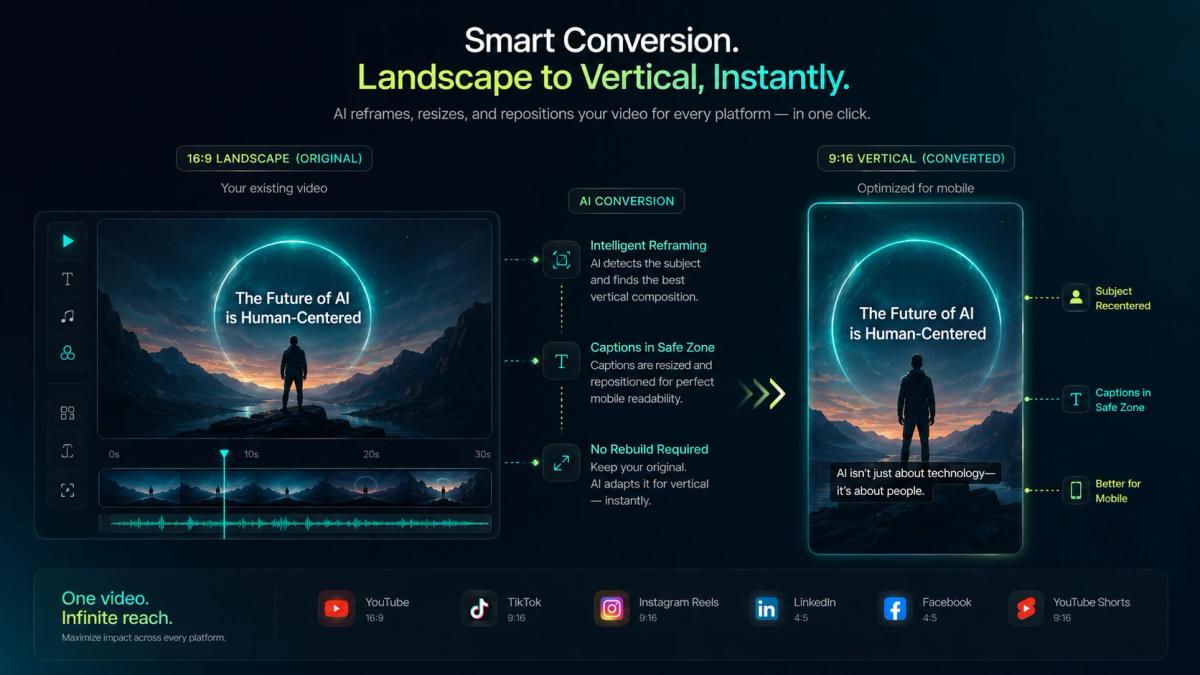
A better vertical video workflow starts with the idea that changing the format should preserve as much of the original creative work as possible.
The story does not need to change simply because the aspect ratio changed. Neither does the voiceover, music, color treatment, pacing, visual identity, or overall narrative direction. Those decisions are already part of the project. What needs to adapt is the composition.
If a landscape scene becomes vertical, the system should help identify what matters most in the frame and reorganize around it. This is especially important when the video contains several visual elements that must remain readable or recognizable.
Reframing should preserve the point of the shot
Imagine a landscape scene where a presenter stands on one side while a product demonstration takes place on the other. A basic center crop may keep the middle of the frame and remove the very elements that make the shot useful.
Better intelligent reframing needs to account for what is actually important in the scene. Depending on the composition, the right solution may involve repositioning the frame, scaling one element, adjusting the layout, or adapting the scene rather than simply cutting pixels from the left and right sides.
The same principle applies to generated images and video assets. If the system already understands the main subject, background, text, and other visual elements as meaningful parts of the project, adapting the scene becomes much more controlled than treating the finished frame as one flat rectangle.
Captions and graphics need their own space
Subtitles deserve particular attention in 9:16 video because they can occupy a large percentage of the screen. On a landscape video, a subtitle line can sit comfortably across the lower portion of the frame. On a phone screen, the same line may need a different size, position, or line break to remain readable without covering the subject.
Graphics face the same issue. A title designed for the width of a 16:9 video may need to wrap differently in vertical. A logo may need to move. A callout that originally sat beside a presenter may work better above or below them once the frame becomes narrow.
This is why vertical conversion needs to work at the level of individual elements rather than simply at the level of canvas dimensions. The goal is not just to fit the video into 9:16. The goal is to preserve the meaning and readability of the composition after the format changes.
What a Vertical-First Platform Should Handle
If an all-in-one video platform is going to make vertical production genuinely easier, it needs to do more than offer a 9:16 canvas. A useful workflow should support:
- Native vertical composition, so creators can start in 9:16 when vertical is the primary destination rather than designing horizontally first and converting later.
- Multi-format adaptation, so one project can produce different aspect ratios without requiring completely separate timelines for every version.
- Intelligent reframing, so subjects, captions, graphics, and other important elements can adapt when the dimensions change.
- Connected asset management, so clips, generated visuals, voiceovers, subtitles, music, and effects remain linked to the same project while different versions are created.
The important idea is that all of these elements should remain connected.
Aspect ratio should not exist as an isolated export option at the very end of production. It affects how the scene is framed, where captions appear, how graphics behave, how assets are positioned, and ultimately how the viewer experiences the story.
One Project Should Produce More Than One Format
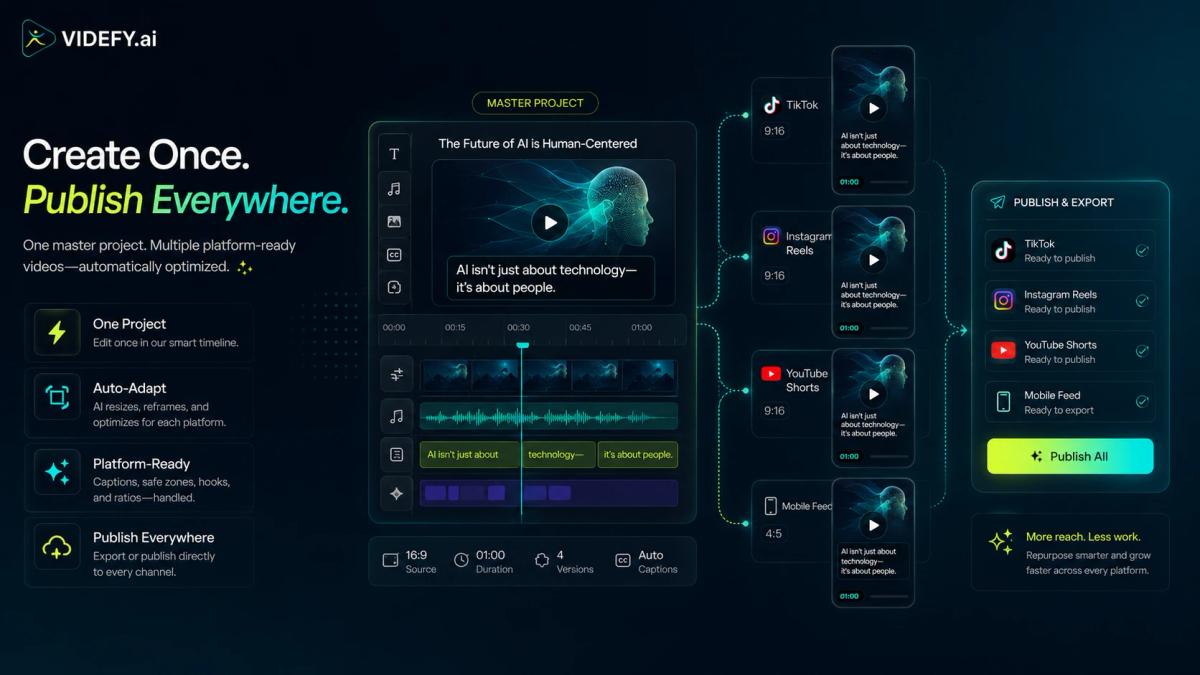
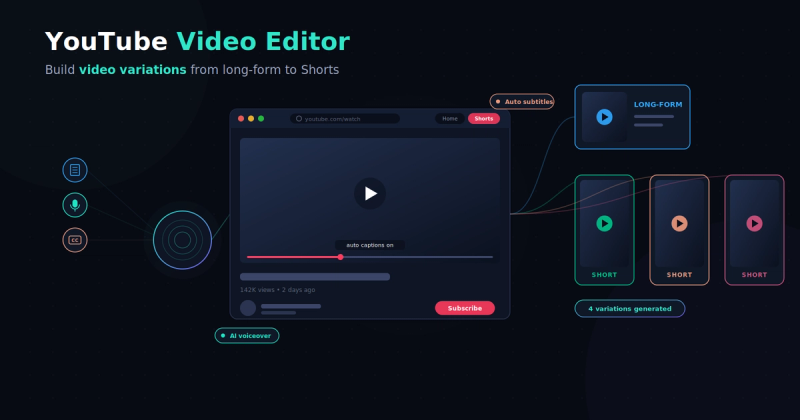
A modern video rarely has only one destination. A creator may start with a longer YouTube video and later identify a 30-second segment that works as a Short. A marketing team might produce a landscape product demonstration for a website and then adapt the same material into vertical social content. A podcast clip may need a 16:9 version for YouTube and a tighter 9:16 version with larger subtitles for mobile feeds.
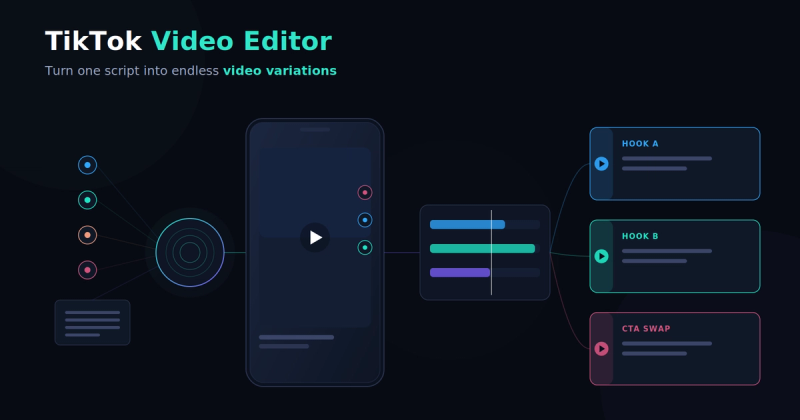
The inefficient approach is to treat every one of those outputs as an entirely separate production. The more scalable approach is to create a strong base project and build variations from it.
This is where short-form video production becomes much easier to manage. The creator is not researching the topic again, rewriting the core message, generating the same voiceover, or recreating the visual identity. The creative foundation already exists. The work now is adaptation.
That distinction matters because content production scales much better when every new format does not require a complete restart.
A good base project can become several different outputs while still sharing the same underlying story, assets, audio, and creative direction. Each variation can then be optimized for its destination without breaking its connection to the original work.
Vertical Video Is Also a Workflow Problem
It is easy to think of vertical video primarily as a design issue: make the canvas tall, reposition a few things, and the problem is solved. In practice, the larger challenge is operational.
Imagine a team producing ten campaign videos, with each video requiring one landscape version and two vertical variations. What began as ten creative projects may quickly become 30 deliverables.
If every additional version requires someone to manually duplicate the project, resize elements, reposition subjects, repair captions, check safe areas, and export again, the workload grows much faster than the underlying creative work.
The message did not triple. The research did not triple. The voiceover did not triple. The amount of formatting and production management did.
That is exactly why connected workflows matter. Instead of moving through a process like:
Project → export → new tool → resize → repair → export again
the production model becomes closer to:
Project → adapt → review → export variations
The difference may look small on paper, but across dozens or hundreds of assets, it changes how efficiently a team can operate.
Where Videfy Fits Into the Workflow
Videfy is built around the idea that video creation should happen as one connected process, not a collection of isolated steps across different tools.
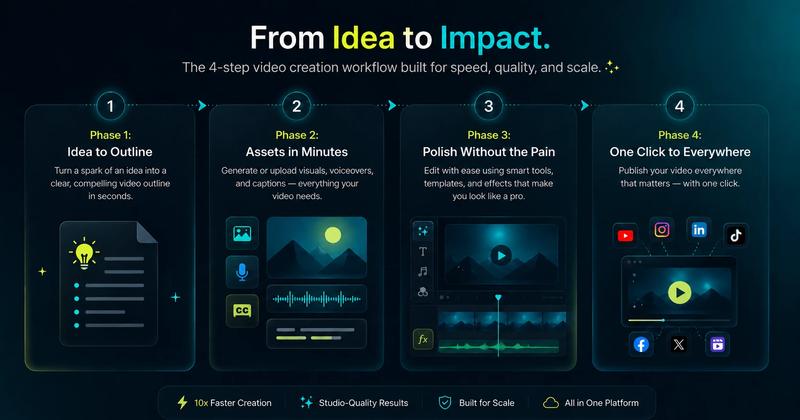
An idea can move into story and scene development, asset generation, voiceover, video generation, editing, subtitles, and final output while remaining part of the same production flow. That matters for vertical content because aspect ratio is only one part of the project.
A finished video still has a story, scenes, visual assets, audio, subtitles, pacing, transitions, and editing decisions. When those elements stay connected, creating a vertical version becomes an adaptation of the existing project rather than a complete rebuild.
That is especially valuable when several variations are required. The base creative work can remain consistent while the composition is adjusted for another viewing environment.
The goal is not simply to automate every decision. Creators still need control over what stays in frame, where graphics appear, how subtitles are presented, and whether the adapted version still communicates the same idea effectively.
What changes is how much repetitive production work is required to get there.
Build for the Screen People Actually Use
Vertical video is not difficult because 9:16 is technically complicated. It becomes difficult when the workflow assumes that vertical is an exception.
Creators should not have to finish a video and then discover that preparing it for mobile means rebuilding large parts of what they already approved. A better system treats format as part of the creative process from the beginning, allowing scenes, subjects, subtitles, graphics, and assets to adapt without disconnecting them from the original project.
The result is not simply faster exporting. It is less repetitive production and more flexibility.
Horizontal video isn't disappearing, and it doesn't need to. The real requirement is adaptability. One creative project should be able to move between formats without turning every new aspect ratio into another round of manual reconstruction.
That is where vertical video production needs to go.
If your next idea needs to work across vertical and horizontal formats, start creating with Videfy and keep your story, assets, editing, subtitles, and video variations connected from creation through export.
Learn with Videfy
Discover tutorials, AI best practices, feature updates, and creative inspiration to level up your video production.